Materials, standards, and sleep
Choosing an Organic Mattress: Materials, Certifications, and Comfort
An organic mattress is not a single material or a guarantee of perfect sleep. It is a set of choices—about fibers, foams, construction, sourcing, and verification—made beneath the sheet. Understanding those choices turns a confusing label into a more useful question: what, exactly, is this mattress made of, and how well does it suit the person who will sleep on it?
Mattress shopping has a peculiar talent for making the most ordinary act—lying down—sound like an advanced discipline. A person begins with a familiar problem, perhaps a mattress that sags in the middle, or one that feels too warm by two in the morning. Before long, the language of shopping has expanded to include organic latex, certified cotton, chemical emissions, pressure relief, coil counts, and a small forest of seals. Some of those details matter. Others matter only when they can be connected to a clear standard or a real comfort preference.
Organic mattresses can vary substantially. One may use certified organic cotton in its cover but rely on other materials in the comfort layers; another may combine several verified components in a different construction. The word “organic,” standing alone, does not tell you whether a mattress is firm, resilient, breathable, durable, or suitable for your body. Nor does a pleasant description reveal which parts of the mattress were certified, by whom, and under what criteria.
A sensible comparison begins by separating three questions that advertising often blends together: What is in the mattress? What do its certifications actually cover? And does its construction provide the support and feel you need? Naturepedic mattresses, like any other mattress range, are best considered through those same questions rather than through a brand name or a single environmental claim.
Start with the materials, not the adjective
A mattress is a layered object. The cover, comfort layers, support core, fire barrier, adhesives, and quilting can all involve different materials and manufacturing choices. When a label says “organic mattress,” look for an explanation of the individual components. Is the cotton in the cover certified organic? What provides the cushioning? What forms the support core? Does the maker identify the fire-protection method and explain whether adhesives are used?
These are not merely technical questions. Materials shape the way a mattress responds under weight, releases heat, and changes over time. A material’s origin may be important to a buyer, while its density, resilience, or construction may be more relevant to how the mattress feels at night. Ideally, a manufacturer makes both kinds of information available, allowing a reader to assess sourcing and comfort without mistaking one for the other.
Cotton and wool
Cotton is commonly used in mattress covers and quilted layers. Its feel depends not only on whether the fiber is organic, but also on the fabric, thickness, quilting, and materials beneath it. A cotton cover can contribute a familiar, textile-like surface; it cannot, by itself, tell you how supportive the mattress will be.
Wool may appear in a mattress as padding or as part of a fire barrier. Its role and quantity vary by design. Ask whether the wool is used in a thin quilted layer, a thicker comfort layer, or for another purpose. A material name can sound reassuringly complete while hiding a much more complicated construction.
Latex
Latex is used in some mattresses for cushioning and support. It can feel buoyant and responsive: rather than swallowing the sleeper, it often pushes back with a spring-like sensation. But “latex” does not automatically mean “organic.” Natural latex, blended latex, and synthetic latex are not interchangeable descriptions, and a mattress may use latex alongside other materials. Look for the maker’s exact account of the latex type and the scope of any relevant certification.
Foam, springs, and internal construction
A mattress may contain foam, an innerspring unit, or a combination of support systems. The feel depends on how those layers interact: a soft upper layer over a firmer core behaves differently from a uniformly firm surface. Springs may add bounce and airflow; foam can provide contouring or a more even feel, depending on its formulation and density. These broad tendencies are not guarantees. Two mattresses with similar material labels can feel strikingly different.
Ask for a layer-by-layer description rather than relying on a general phrase such as “all-natural.” A useful description distinguishes the materials in the cover from those in the comfort layers and support core. It also identifies what the manufacturer does not claim. Precision is often more informative than a sweeping promise.
Certifications: what a seal can—and cannot—tell you
Certifications are valuable because they turn certain claims into claims that can be checked against a defined standard. They are not universal endorsements of a mattress, and they do not all evaluate the same thing. One may address organic fiber content; another may focus on emissions, chemical restrictions, or responsible sourcing. The name of a certification is only the beginning of the inquiry.
First, identify the exact product or component covered. A certification may apply to a textile, a material, a facility, or a finished product. A mattress that includes a certified fabric is not necessarily certified in its entirety. Second, check what the standard measures. Certification does not usually establish whether a mattress is comfortable, whether it suits a particular sleeping position, or how long it will retain its feel in a specific household.
Third, look for documentation. Manufacturers should be able to specify the certifying body and explain the relationship between the standard and the mattress being sold. If a claim is important to you, ask for a current certificate or a product-level explanation rather than assuming that a logo on a general brand page applies to every model and every layer.
- Organic-content claims: Ask which fibers are certified and whether the claim applies to the cover, a particular layer, or the complete product.
- Emissions standards: These concern emissions under a defined testing program; they should not be confused with an organic-content certification.
- Material-specific standards: A standard may apply to latex, cotton, wool, or another component without covering the whole mattress.
- Supply-chain claims: Ask whether a certification addresses processing or sourcing and what stages of the chain it includes.
The careful reader resists two opposite errors. The first is treating any seal as a complete guarantee of health, sustainability, and comfort. The second is dismissing certifications as decoration. A well-matched certification can be meaningful evidence about a defined issue; it simply cannot answer every question at once.
Comfort is personal, but it is not mysterious
The word “comfort” appears everywhere in mattress descriptions, though it is less a property of the mattress than a meeting between mattress and sleeper. Body weight, shape, sleeping position, temperature preferences, movement, and personal sensitivity to pressure all influence the result. A mattress described as medium can feel quite different to two people, and firmness labels are not perfectly standardized across makers.
Side sleepers often pay close attention to pressure at the shoulders and hips. Back sleepers may prioritize a surface that supports the lower back without feeling rigid. Stomach sleepers may prefer a firmer feel, though individual needs differ. These are useful starting points, not rules that can diagnose anyone’s ideal mattress. If pain is persistent or significant, a mattress guide is not a substitute for advice from a qualified health professional.
Consider what happens during a typical night rather than what feels impressive in a brief showroom test. Does the mattress allow you to change position without effort? Do you feel supported rather than suspended? Does it retain heat in a way that disrupts sleep? For couples, does movement on one side travel noticeably to the other? Such observations are more useful than trying to settle the entire question with a single firmness number.
When possible, review the trial period, return conditions, delivery requirements, and warranty before purchase. A trial can help, but its practical value depends on the details: how long it lasts, whether a return fee applies, and what condition the mattress must be in. A warranty, meanwhile, is not an assurance that a mattress will feel unchanged for its entire term. Read what it covers, what it excludes, and how indentation or structural failure is defined.
How to evaluate Naturepedic mattresses
Naturepedic is a name readers may encounter while researching organic mattresses. The useful approach is not to assume that a brand’s general reputation answers the question, but to examine the particular model under consideration. Product lines can differ in feel, materials, construction, and available certifications. Details should be verified at the model level, since specifications may change and one mattress’s construction should not be inferred from another’s.
For a Naturepedic mattress, begin with the product’s complete materials description. Note which layers contain organic materials, which contain other materials, and what provides the support. Then inspect the certification information: identify the certifying organizations, the scope of each standard, and whether the documentation is connected to the specific model. A clear product page should let you distinguish verified claims from broad environmental language.
Next, set those facts beside your comfort priorities. If you dislike a sinking sensation, focus on the mattress’s feel and responsiveness, not just its material list. If you tend to sleep warm, ask how the construction is intended to manage heat, while remembering that bedding, room temperature, and individual physiology also matter. If you share a bed, consider motion transfer and whether the available sizes and foundations fit your room.
There is no contradiction in caring about both sourcing and comfort. A mattress can have carefully documented materials and still be the wrong firmness for its owner. Nor does a comfortable first impression settle questions about what is inside it. A sound choice is the one whose materials are legible, whose claims are appropriately bounded, and whose feel is compatible with the way you sleep.
A practical comparison checklist
Before you compare models, write down the features that matter most. A short list keeps the conversation from being hijacked by whichever feature has the largest type on the label.
- Describe your current problem. Is the mattress too soft, too firm, too warm, noisy, or simply worn out? A specific complaint creates a useful standard for comparison.
- Record your preferred feel. Think in plain language—buoyant, cushioned, firm, or closely contouring—rather than assuming a firmness number will translate identically between brands.
- Map the materials. Identify the cover, comfort layers, support core, and fire barrier. Note what is specified and what is not.
- Read certification scope. Confirm which materials or processes are covered, and seek model-specific documentation for claims you consider essential.
- Check dimensions and foundations. Verify mattress size, depth, bed-frame compatibility, and any foundation requirements.
- Review care and practical terms. Understand cleaning guidance, trial conditions, delivery arrangements, return fees, and warranty exclusions.
- Compare like with like. Evaluate similarly sized mattresses with comparable support needs, rather than treating every organic mattress as one category.
This method is deliberately unglamorous. It replaces a vague feeling that a mattress is “clean” or “natural” with a record of what the maker says and what the buyer needs. In a marketplace crowded with adjectives, a few precise questions can be a form of self-defense.
Common misunderstandings
“Organic” means every component is organic. Not necessarily. The claim may refer to particular fibers or components. Read the certification scope and the full materials list.
A higher price guarantees a better night’s sleep. Price may reflect materials, construction, manufacturing, or distribution, but it cannot predict personal comfort. A more expensive mattress can still be a poor match.
Certifications prove a mattress is non-toxic in every sense. Certifications are bounded by their standards and testing methods. Avoid translating a specific certification into a universal claim about risk or health.
Natural materials are automatically cooler. Temperature depends on the whole sleep system, including the mattress construction, sheets, duvet, room, and sleeper. Material labels alone do not settle it.
One firmness level suits everyone with the same sleeping position. Position is one consideration among many. Body shape, preference, pain history, and movement can alter what feels supportive.
The bedroom beyond the mattress
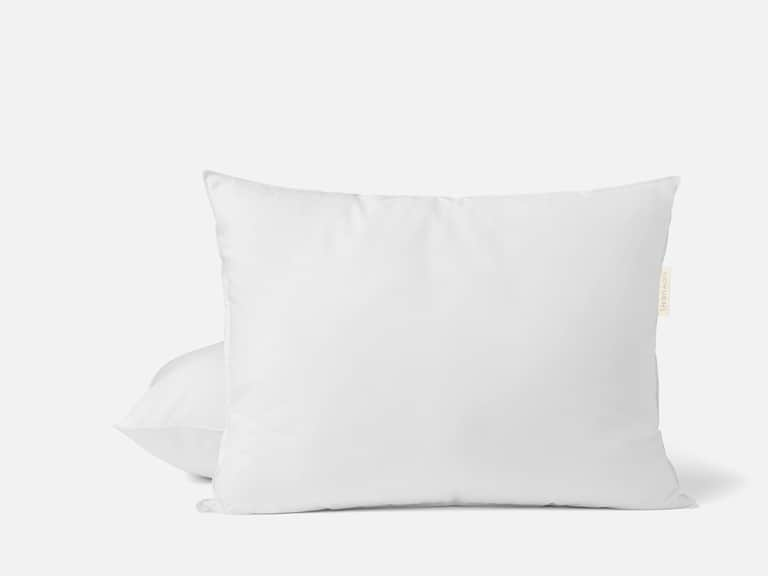
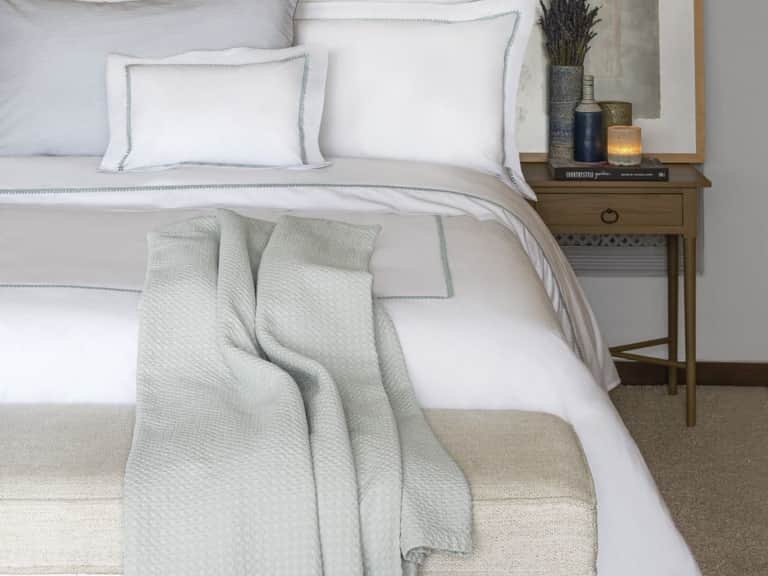
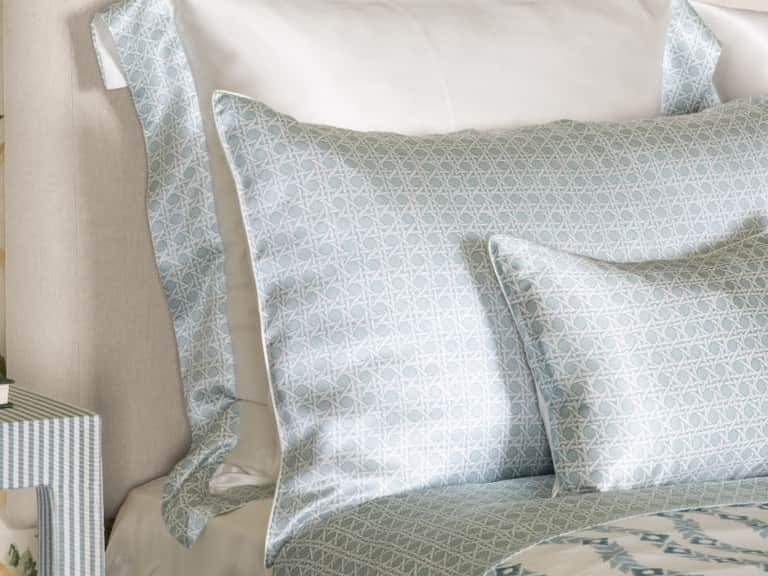
A mattress is the largest decision in the bed, but it is not the only thing a sleeper feels. Sheets, a duvet, a pillow, and the room’s temperature all contribute to the small climate beneath the covers. Breathable bedding may change how warm a bed feels; a pillow with an unsuitable loft may make an otherwise comfortable mattress feel wrong. It is useful to consider the bed as a system, without asking one component to compensate for every other one.
Care matters, too. Follow the manufacturer’s instructions for rotating, cleaning, and protecting the mattress. A suitable protector can help limit stains and everyday wear, but it should be compatible with the mattress’s care guidance and should not be treated as a substitute for a warranty. Regular maintenance does not make a mattress last forever; it simply helps preserve the conditions in which it was designed to be used.
Finally, remember that the bedroom is not a laboratory. People sleep differently through the year, and a mattress that seems unfamiliar on the first night may take time to assess. Keep track of what changes and what does not. If a trial period is available, use it intentionally rather than waiting until its last day to decide how the mattress feels.
A decision made in layers
Choosing an organic mattress is less like finding a perfect label than reading a layered account. The materials tell one part of the story. Certifications help establish which claims have been evaluated and where their boundaries lie. Construction and comfort determine whether the mattress works in the ordinary, nightly sense—whether it supports, cushions, and accommodates the person who actually sleeps on it.
Naturepedic mattresses deserve the same careful, model-by-model consideration as any other option. Ask what each layer contains, what the relevant certifications cover, and whether the firmness and construction suit your preferences. Treat promotional language as a prompt for questions, not as the answer itself. If the information is clear and the mattress feels right under realistic conditions, you have made a more informed decision than any slogan could make for you.
In the end, the best buying guide is neither a seal nor a thread count, neither an evocative description nor a confident promise. It is the combination of transparent materials, verifiable claims, practical terms, and a surface on which you can imagine spending a great many quiet hours. The mattress is hidden beneath the bedding, but the reasoning behind the choice need not be.